Wire Mesh vs Solid Deck Trolleys: Which Is Right for Retail Replenishment?
Compare wire mesh and solid deck stock trolleys for retail replenishment. Explore load support, nesting and castor options, then discuss your requirements.
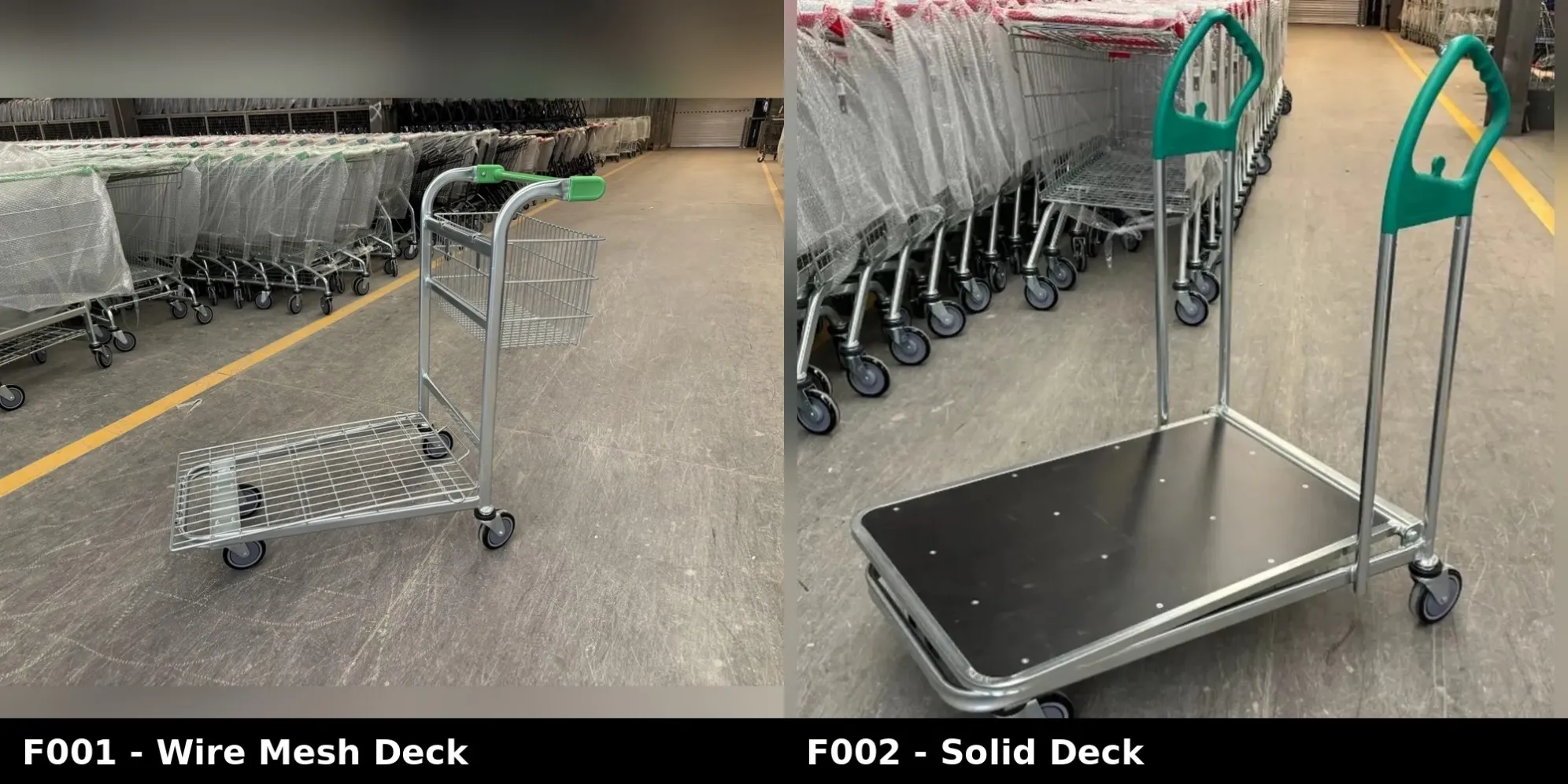
A solid deck is worth considering when small packs, flexible bags or mixed cartons need a continuous supporting surface. A wire mesh deck can suit larger goods that sit securely across the grid. Neither deck type alone determines load capacity: check the complete trolley’s rating, load distribution, castors and working environment before ordering.
For retail equipment distributors, shopfitters and store operators, the right choice starts with the goods staff move every day—and the route from the stockroom to the shop floor.
What Will Your Staff Carry Each Day?
Large cartons with flat bases may sit comfortably on either platform. Small packs, flexible bags or cartons with narrow feet may catch in mesh openings or sit unevenly.
If staff regularly cover the mesh with cardboard, a continuous surface may suit the task better. Send your supplier a photograph of a typical load, including the smallest items. This gives a clearer starting point than asking for a “strong trolley”.
Wire Mesh and Solid Deck Comparison
| Selection point | Wire mesh deck | Solid board deck |
|---|---|---|
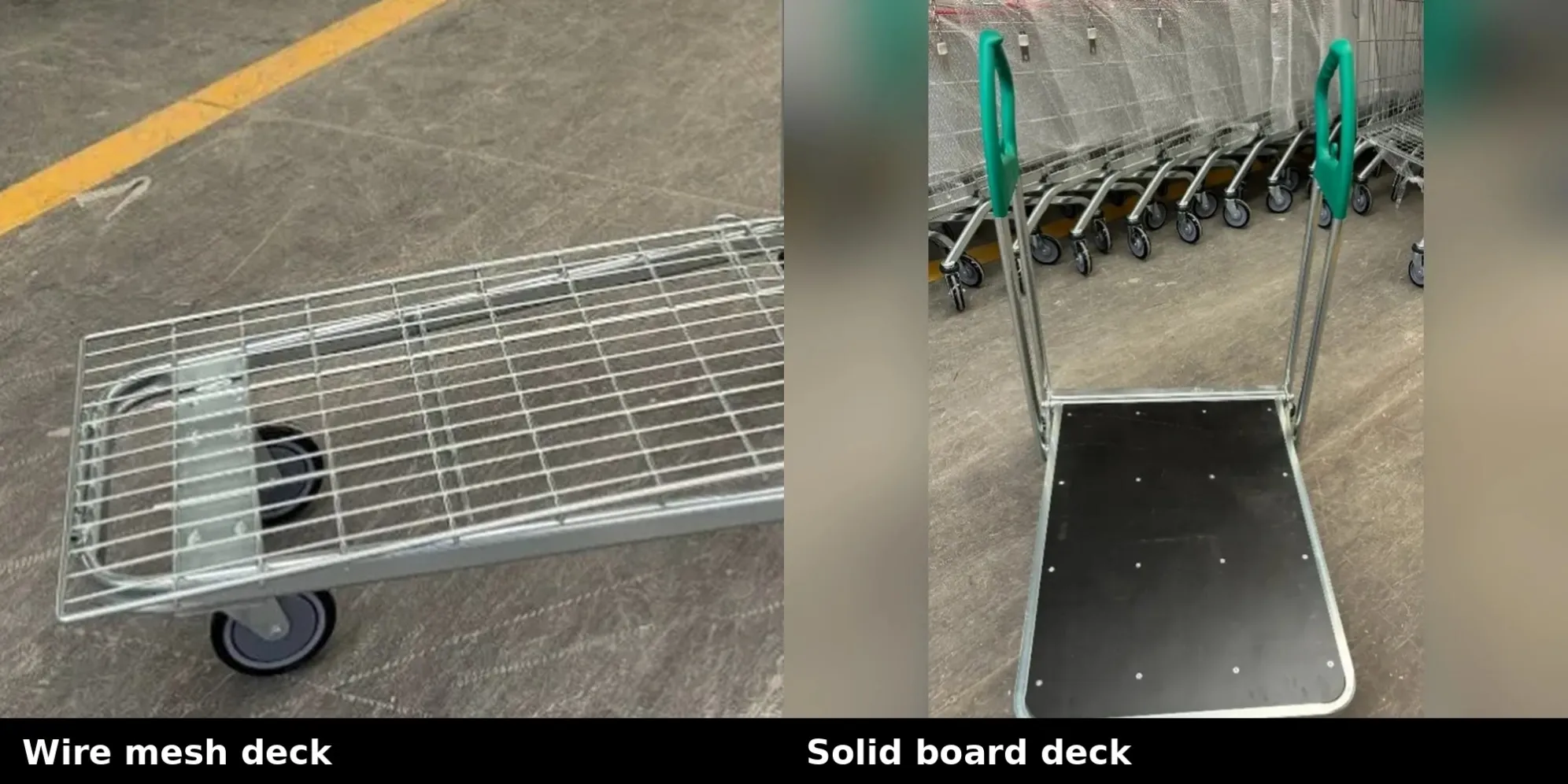
| Large flat cartons | Can suit goods supported securely across the grid | Provides a continuous supporting surface |
| Small or flexible items | Check openings for catching or tipping | Helps prevent items catching in openings |
| Dust and loose debris | Can fall through onto the floor | Stays on the surface until removed |
| Cleaning | Grid intersections need attention | Flat surface can be easier to wipe, depending on finish |
| Moisture | Check finish and corrosion protection | Check board and edge protection |
| Load capacity | Confirm complete model and loading conditions | Confirm complete model and loading conditions |
Does a Solid Deck Mean a Stronger Trolley?
Not necessarily. The platform, supporting frame, welds, castors and connections all affect performance. A continuous deck does not by itself establish the capacity of the complete trolley.
Several cartons spread across a platform place different demands on it from one compact, heavy item resting on a small area. Confirm the rated capacity and the conditions that apply to it, including whether the intended load creates concentrated pressure.
If an existing trolley has bent or failed, share photographs of the affected area and details of the load. These help your supplier assess the replacement rather than repeat the same specification.
Check the Board Specification and Working Environment
“Solid deck” describes the loading surface, not every property of the board. Ask about the material, thickness, finish, edge protection and replacement options.
If a board is described as fire-retardant, request the relevant specification or documentation where this matters to your project. That description alone does not establish suitability for wet areas, outdoor storage or a particular cleaning routine.
Castors and Dimensions Affect Daily Handling
A retail stock trolley may need to pass through a narrow doorway, turn around shelving, cross a threshold and remain stationary during unloading. Check the complete trolley against the actual route.
- Overall dimensions and turning space at the narrowest point.
- Usable platform size and the footprint of typical cartons.
- Castor type and capacity for the floor surface and thresholds.
- Brake arrangement for loading and unloading.
- Handle, basket and rail layout for access to the goods.
Do not assume that mesh will always be easier to push or that a board deck will always handle better under load. Compare the complete trolley, including its dimensions, weight and castor arrangement.
Check Nesting Space Before Ordering Several Units
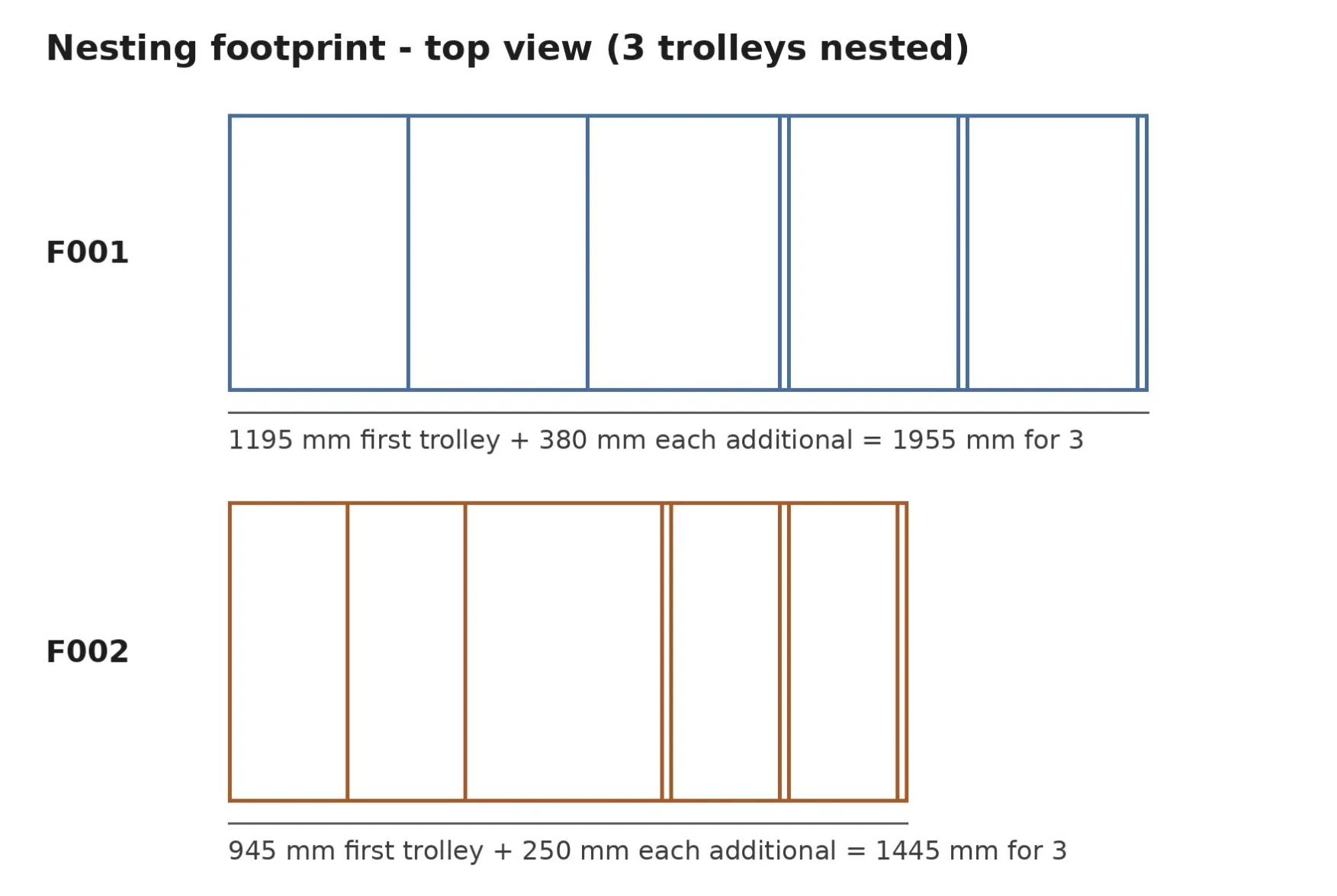
For distributors and stores buying several trolleys, storage space deserves attention. Ask for the overall dimensions, the additional space occupied by each nested trolley and a photograph or drawing showing the nesting arrangement.
Also confirm whether deck options share the same frame. Our F001 mesh-deck and F002 board-deck trolleys are separate models with different dimensions and nesting arrangements. They should be selected when ordering; the decks are not interchangeable between these models.
Compare Our Stock Trolley Options
Explore the F001 wire mesh flatbed trolley with basket, the F002 solid deck flatbed trolley, and the F002-1 solid deck version with an end rail and braked castors. Compare the current dimensions, load information and nesting details on each product page before selecting a model.
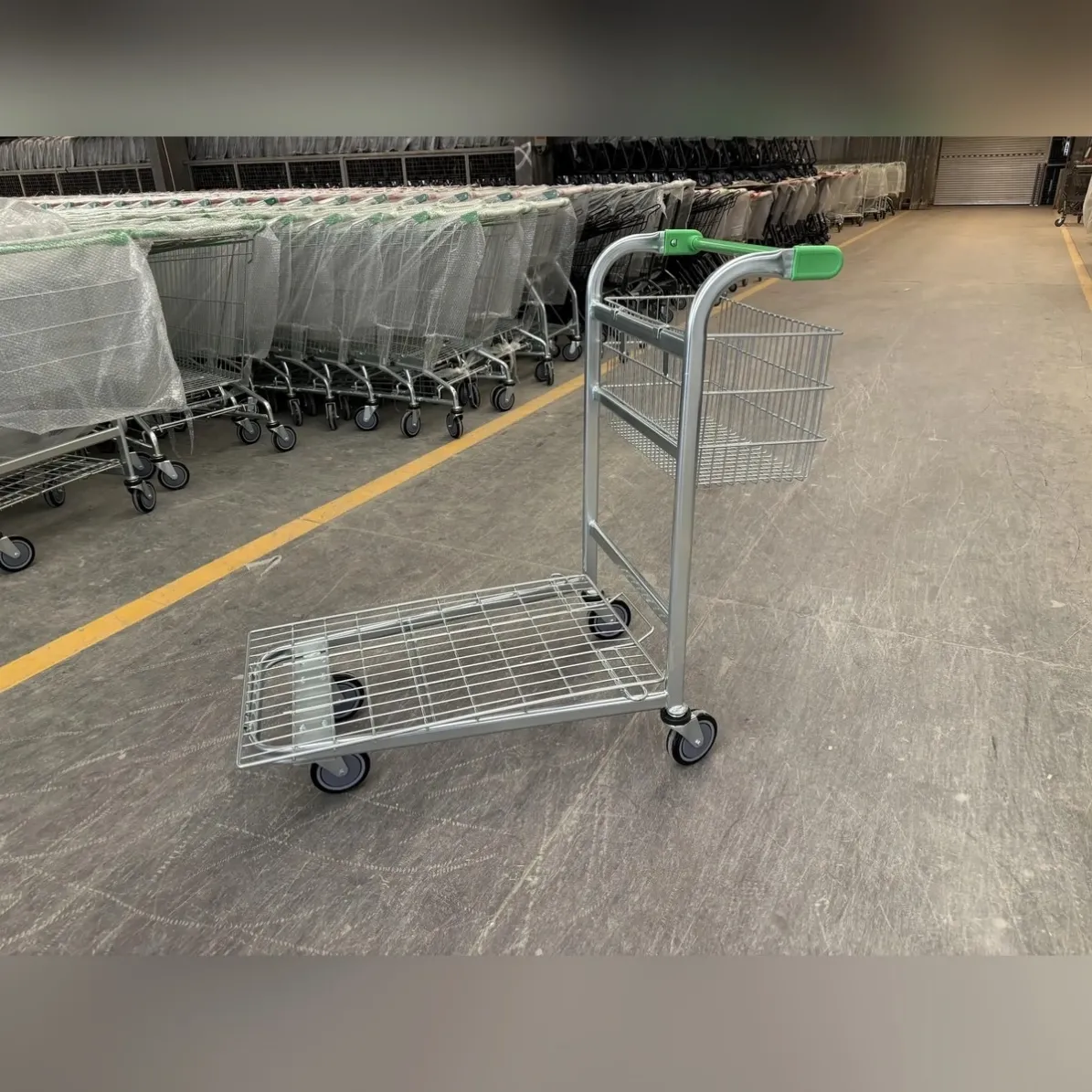
F001 Warehouse Flatbed Stock Trolley with Basket
Wire mesh deck, with basket
1195 × 590 × 1060 mm · Rated load 150 kg · Nesting +380 mm per trolley
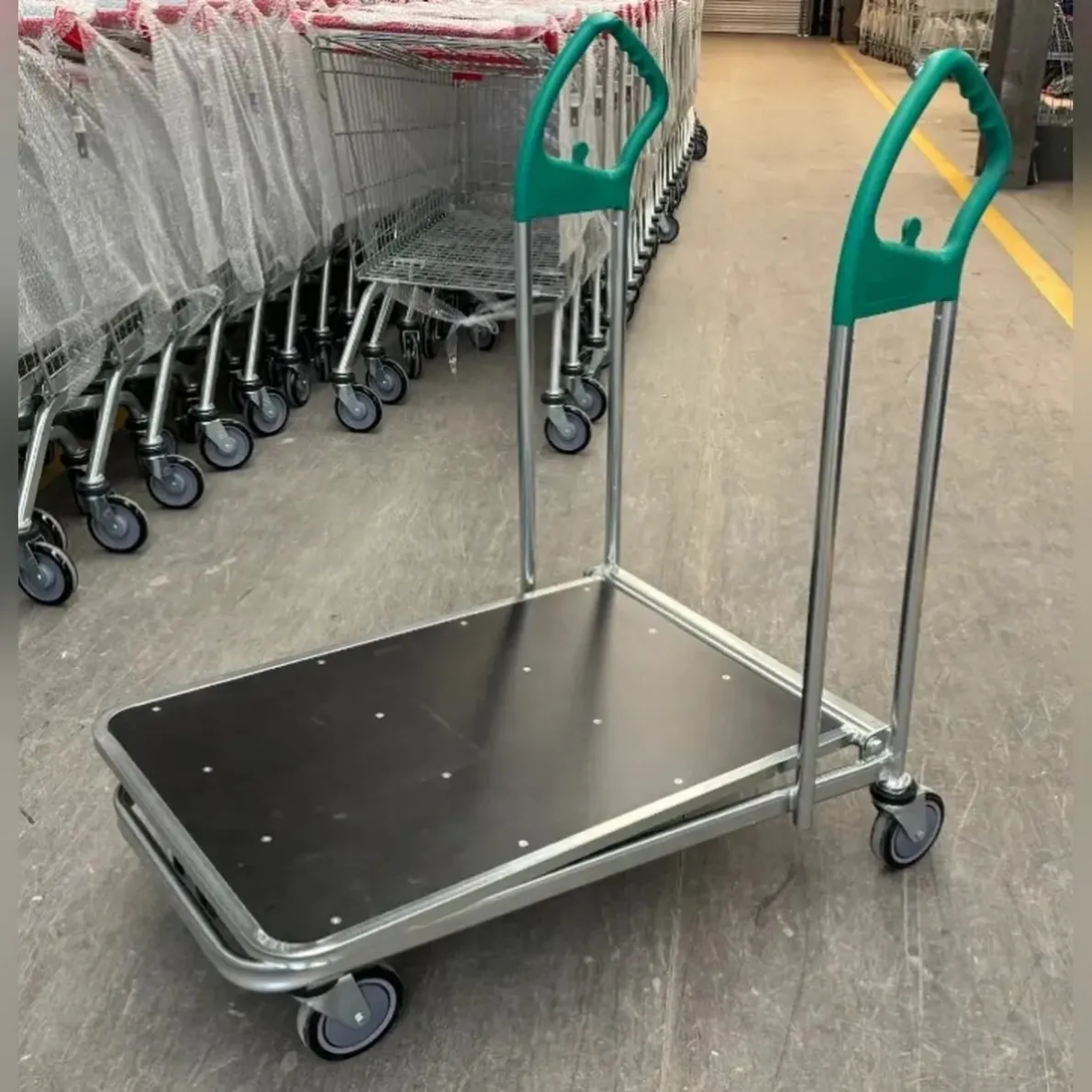
F002 Warehouse Flatbed Trolley with Solid Deck
Fire-retardant board deck
945 × 640 × 1100 mm · Rated load 150 kg · Nesting +250 mm per trolley
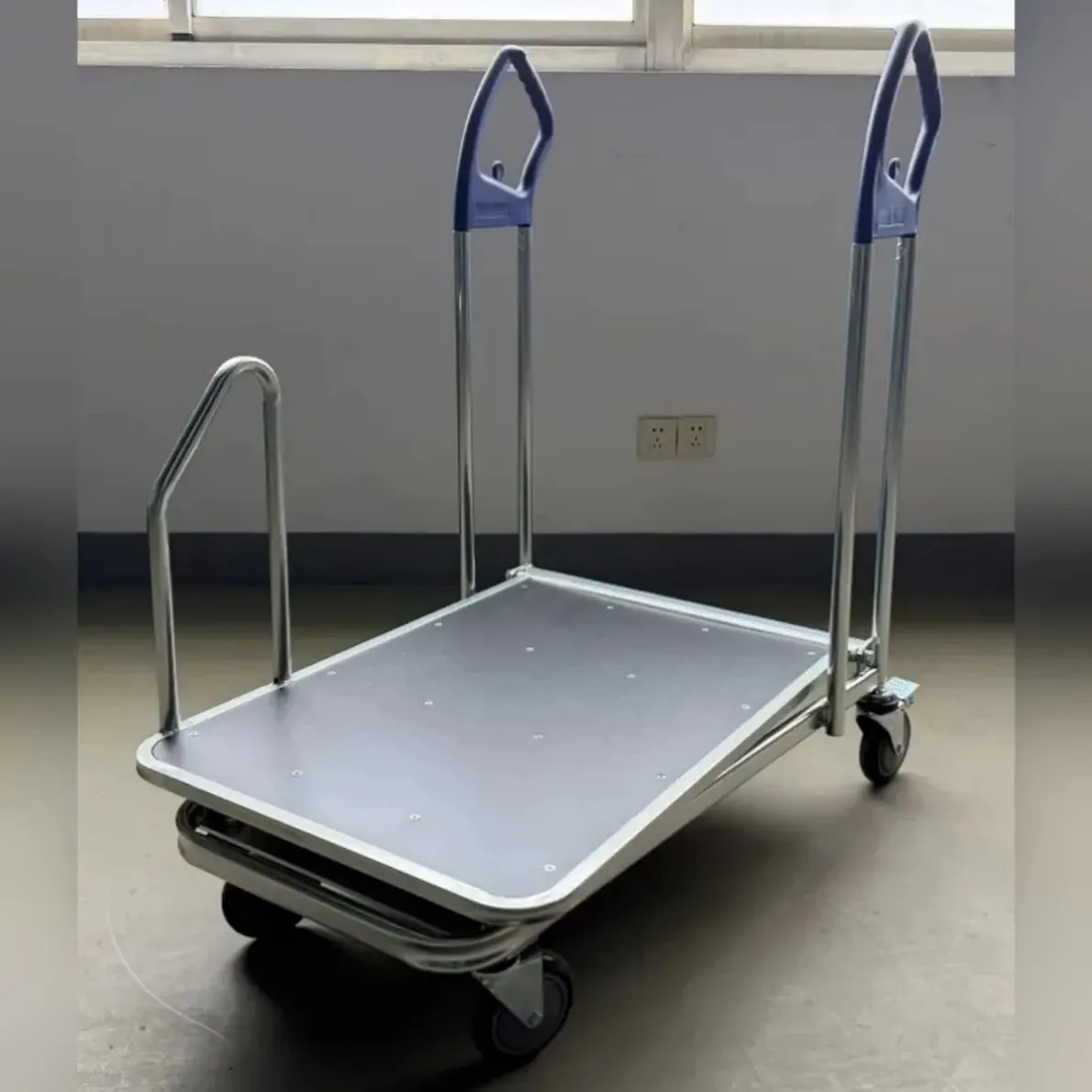
F002-1 Warehouse Flatbed Trolley with Solid Deck and End Rail
Fire-retardant board deck, end rail, braked castors at the handle end
945 × 640 × 1100 mm · Rated load 150 kg · Nesting +250 mm per trolley
Need Help Choosing a Deck?
Send us a photo of what you carry, the maximum load weight and your estimated quantity. We can help check a suitable model and discuss any custom requirements.
Discuss Your Trolley Requirements
Sourcing Trolleys for Resale or a Store Project?
Suzhou Smart Shop Supplies is an integrated supplier of retail store equipment. We help retail equipment distributors and shopfitters compare standard trolley models and discuss custom requirements.
We work directly with partner factories and coordinate specifications, quality checks and shipping. If you are sourcing other store equipment for the same order, let us know so we can discuss combined shipment options.
Frequently Asked Questions
Is a solid deck trolley stronger than a wire mesh trolley?
Not automatically. Capacity depends on the complete trolley design and the conditions that apply to its rating. Check the frame, deck support, castors and intended load distribution rather than choosing by deck material alone.
Can the mesh and board decks be interchanged?
Our F001 mesh-deck and F002 board-deck trolleys are different models. Their decks are not interchangeable. Confirm the model, dimensions and configuration before ordering.
Can I request different castors or an end rail?
Send us the required configuration and intended use. Available options depend on the trolley model, specifications and quantity, so we will confirm feasibility for your enquiry.
Is there a minimum order quantity for custom trolleys?
Custom requirements may involve a minimum order quantity. Share the changes you need and your estimated quantity so we can discuss the details.
Discuss Your Stock Trolley Requirements
For a model recommendation or quotation, send a photo or description of your goods, the maximum load weight and your estimated quantity. If you have doorway restrictions, nesting requirements or other store equipment to source, include those details too.
Discuss Your Trolley Requirements
Tell Us What You Need to Move
Send your requirements through our contact form. Include a photo or description of your goods, the maximum load weight and your estimated quantity.
You can also send photos by email after submitting.