Jun 26, 2026Product Blogs
Shopping Rolling Basket Types: A Complete Guide for Retailers (2-Wheel vs. 4-Wheel)
Choosing the right Shopping Rolling Basket Type is about matching the equipment to your store layout and your customer's shopping behavior.
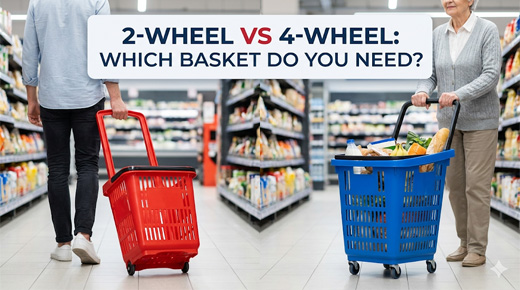
Quick Summary for Decision Makers:
- The 2 Main Types:
- 2-Wheel (Tilt & Pull): Best for narrow aisles and small convenience stores.
- 4-Wheel (360° Spinner): Best for supermarkets and heavy loads (Zero hand weight).
- Handle Types: Integrated Plastic handles are more durable and hygienic than Aluminum Telescopic handles.
- Capacity Logic: 30L-40L replaces hand baskets; 55L-80L replaces shopping carts.
One size does not fit all. If you put a giant 80L rolling basket in a small convenience store, you block the aisles. If you put a small 2-wheel basket in a large DIY store, customers will fill it up in 2 minutes and stop shopping. Choosing the right Shopping Rolling Basket Type is about matching the equipment to your store layout and your customer's shopping behavior. As a manufacturer, we see buyers making the wrong choice daily. This guide classifies rolling baskets by Mechanism, Capacity, and Handle Design to help you make the right investment.
1. Classification by Mechanism: The Movement Logic This is the most critical distinction. It changes how the customer physically interacts with the basket.
- Type A: 2-Wheel Rolling Baskets (The "Tilt & Pull") These look and act like a carry-on suitcase. The customer must tilt the basket back to engage the wheels.
- Mechanism: 2 fixed wheels at the back + 2 stoppers (feet) at the front.
- Pros:
- Agile: Easier to control in tight corners.
- Stable: It won't roll away when parked on a slope.
- Cost: Generally cheaper than 4-wheel models.
- Cons:
- Partial Weight: The customer still bears about 20-30% of the weight in their hand/wrist.
- Not ideal for very heavy items (liquor/hardware).
- Type B: 4-Wheel Rolling Baskets (The "Push & Glide") These act like a mini shopping cart. All four wheels touch the ground.
- Mechanism: Usually 2 fixed rear wheels + 2 front 360° swivel casters (or 4 swivel casters).
- Pros:
- Zero Weight: The floor takes 100% of the load. Even an elderly customer can move 40kg of goods with one finger.
- Maneuverability: It spins 360 degrees.
- Ticket Size: Because it feels weightless, customers tend to buy more.
- Cons:
- Space: Requires slightly wider aisles to turn comfortably.
2. Classification by Capacity: Matching Store Format Don't guess the size. Match it to your average transaction volume.
- The "Express" Type (30L - 42L):
- Best For: Convenience Stores (7-11 style), Pharmacies, Bookstores.
- Purpose: A direct upgrade from hand baskets. It fits in narrow aisles (< 1.2 meters) but allows customers to buy heavy drinks without carrying them.
- The "Standard" Type (45L - 55L):
- Best For: Mid-sized Supermarkets, Fresh Food Markets.
- Purpose: The industry standard. It holds a full week's worth of groceries for a single person. Perfect balance of size and capacity.
- The "Maxi" Type (60L - 80L):
- Best For: Liquor Stores, DIY Stores, Hypermarkets.
- Purpose: A substitute for metal shopping carts. It encourages bulk buying (e.g., 6-packs of beer, large tools).
3. Classification by Handle Design: Durability Focus The handle is the second most common failure point after wheels.
- Type A: Telescopic Handle (Aluminum/Iron)
- Design: Like a luggage handle. You press a button, and it slides up.
- Verdict: Looks premium, but has moving parts. Sand and dust can jam the mechanism over time.
- Type B: Integrated / Foldable Handle (All-Plastic)
- Design: A single piece of reinforced plastic that folds flat.
- Verdict (Factory Pick): Highly Recommended.
- Hygienic: Easy to wipe clean (Antimicrobial friendly).
- Durable: No metal parts to rust; no complex mechanism to jam. It flexes instead of bending.
4. Comparison Table: At a Glance Use this table to decide which type fits your floor plan.
Feature | 2-Wheel Rolling Basket | 4-Wheel Rolling Basket |
Movement Style | Pull Behind | Push Alongside |
Hand Strain | Low (30% weight) | Zero (0% weight) |
Aisle Width | Narrow (Compact) | Standard / Wide |
Elderly Friendly | Medium | High |
Cost | $ | $$ |
Best Scenario | Mini Mart / Express | Supermarket / Big Box |
5. Buying Guide: Which Type Should You Buy?
- Scenario 1: You run a small city-center shop.
- Choice: 32L or 42L / 2-Wheel Type.
- Why: You need high density. These baskets stack efficiently and don't block traffic during rush hour.
- Scenario 2: You want to replace metal carts in a supermarket.
- Choice: 65L / 4-Wheel Type.
- Why: Metal carts are expensive and damage fixtures. A 65L plastic rolling basket offers similar capacity but is silent, safer, and cheaper.
- Scenario 3: You sell heavy items (Wine/Tools).
- Choice: 55L / 4-Wheel Type.
- Why: You must eliminate weight resistance. If the basket feels heavy (2-Wheel), customers stop buying after 2 bottles. With 4-Wheel, they buy a case.
The Ultimate Guide to Upgrading Your Store Baskets
The Big Debate: 2-Wheel Pull vs. 4-Wheel Push
Most store owners assume a basket is just a basket, but the wheel setup changes everything on the shop floor. With a classic 2-wheel design, your customers still have to physically tilt and drag the weight. If you stock heavy items (like bulk liquids) or have a lot of elderly shoppers, you definitely want to upgrade to the 4-wheel "push and glide" models. Since all four wheels stay firmly on the ground, the floor takes 100% of the load. As a bonus, it drastically cuts down on that annoying wheel rattle across your store.
Sizing It Up: Express Aisles vs. Full Supermarkets
Your floor plan dictates your basket size. If you're running a tight convenience store with narrow aisles, stick to the 30L to 42L tilt-and-pull models. They perfectly replace those heavy, uncomfortable hand baskets without causing traffic jams. However, if you're managing a larger supermarket and want to phase out clunky, expensive metal shopping carts, drop in some 65L (or larger) 4-wheelers. They hold nearly as much inventory but are way cheaper, much safer, and completely silent.
Why We Always Recommend All-Plastic Handles
When sourcing baskets, you'll usually see two handle options: aluminum telescopic pull-outs and integrated fold-flat plastic ones. Honestly? Go with the all-plastic. We see it all the time with those metal pull-up handles—give them a few months of heavy use and they start sticking. Or worse, someone leaves them out in the rain and the mechanisms just rust out. That’s exactly why we push the solid plastic molded ones. No springs, no metal tracks to snap, and your team can literally wipe them clean in seconds before closing up.
Keeping Your Entrance Tidy (Stacking Rules)
Floor space is expensive, so how your baskets stack matters. Because our integrated handles fold completely flat against the rim, these baskets have an incredibly tight nesting ratio—meaning you can stack a massive column without eating up your entranceway. Just one pro tip for your staff: never mix 2-wheel and 4-wheel models in the same stacker. They use completely different molds, and trying to jam them together will just leave your team fighting to pull them apart during the morning rush.